


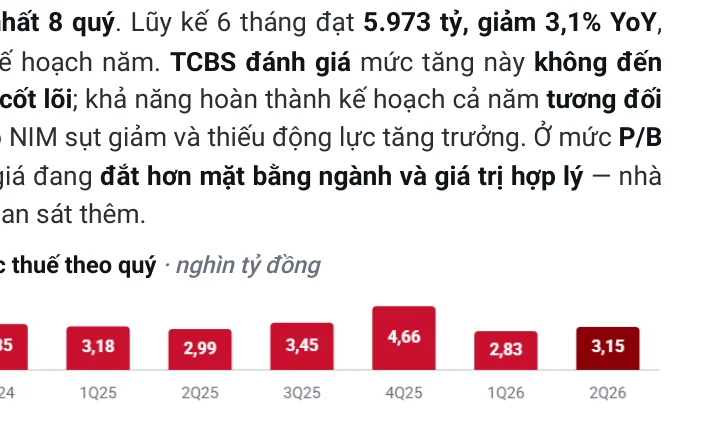
LPBank’s pre-tax profit in Q2 reached 3,147 billion VND (+5.3% YoY), recovering after a dip in Q1. But peeling back the layers, the picture is much more interesting — especially with Mr. Pham Nhat Vuong spending ~6,700 billion to buy nearly 5% of the shares.
- Q2 Pre-tax Profit: 3,147 billion (+5.3% YoY) — recovering after an 11% drop in Q1
- However, profit increased thanks to a sudden spike in service income of 1,915 billion (up 2.25 times) — not from core operations
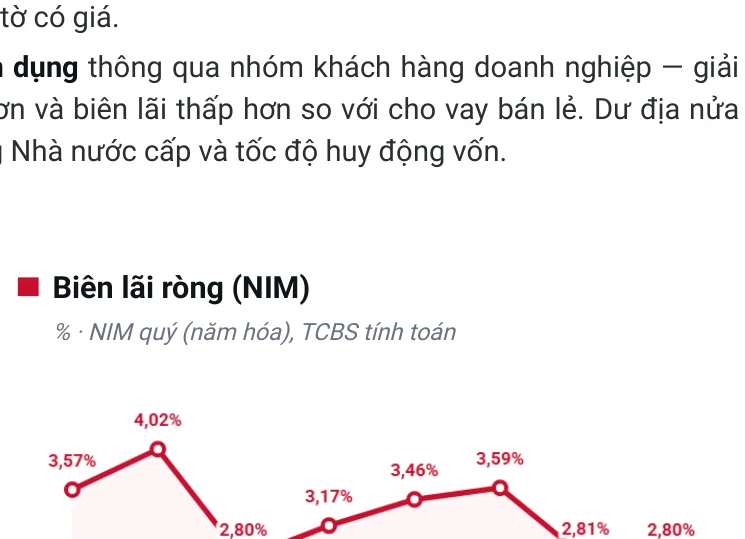
- NIM fell to just 2.80% — the lowest in 8 quarters; CASA at 6.3% is among the lowest in the industry
- Mr. Pham Nhat Vuong bought 4.89% of LPB (~6,700 billion) — a signal of confidence, but expectations are already partially reflected in the price
- TCBS 2026F Pre-tax Profit forecast: 14,726 billion (+3.2%), lower than the plan; P/B at 3.2x — more expensive than the industry average
Profits are up, but the “backbone” is weaker
Anyone looking at LPBank’s Q2 results would see all green: Pre-tax profit +5.3%, total income +23.3% — it looks great. But looking at the components reveals the issues.
Almost all of the increase came from one item: net profit from service activities of 1,915 billion VND, 2.25 times higher than the same period last year and accounting for 31.6% of total income. In the same period last year, this ratio was only 17.3%. Simply put: the bank made much more money from fees this quarter — but this kind of “lump sum” income is usually seasonal, and its repeatability in the coming quarters is unclear.
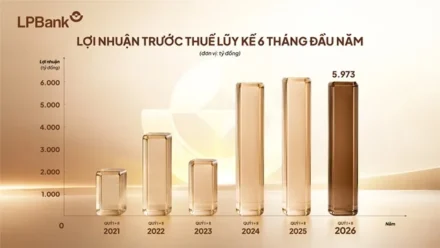
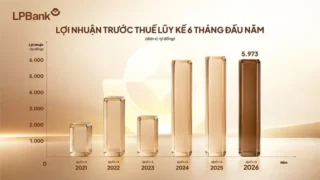
Meanwhile, net interest income — the main source of revenue and the core health measure of a bank — only increased by 4.1%. This is despite outstanding loans growing by 9.6% since the beginning of the year. It feels like opening more stores but the profit earned doesn’t increase. Cumulatively for 6 months, pre-tax profit reached 5,973 billion, down 3.1% compared to the same period — only reaching 39.9% of the annual plan.
NIM at 2.80% — an 8-quarter low, the story of expensive capital costs
The most worrying indicator in this report is perhaps the NIM (net interest margin), which fell to just 2.80%, the lowest in 8 quarters. This is down from 3.17% at the end of 2025.
The root cause: quarterly interest expenses increased by 46.4%, 1.5 times the growth rate of interest income (29.3%). For the whole 6 months, interest expenses increased by 39.6% while interest income only increased by 28.2% — the gap is widening.
Why? CASA — the ratio of demand deposits — is only 6.3%, the lowest in the industry. 93.7% are term deposits, which require interest payments. Demand deposits (which are almost free) even decreased. To compensate, the bank issued more valuable papers (+23.2%) at a higher cost. It’s like drinking soda instead of plain water after exercising — it quenches your thirst, but it’s expensive.
Pham Nhat Vuong buys nearly 5% — a 6,700 billion deal
We can’t forget the “hottest” deal in the market recently: at the end of June, Mr. Pham Nhat Vuong bought 146.2 million LPB shares through a put-through transaction, equivalent to 4.89% of the capital, with a total value of about 6,700 billion VND — close to the 5% ownership cap for an individual in a bank.
Mr. Vuong stated that this is a financial investment and he will not participate in management. For now, the deal serves as a signal of confidence. Looking further ahead, it opens up the possibility of connecting with the Vingroup ecosystem — home loans, electric vehicles, payments — a huge source of demand if it becomes a reality.
However, TCBS also noted that LPB shares have risen from the 46,000 range to 53,500 VND — much of which happened after this news. Expectations have been partially reflected in the price.
A balanced view: a good story but the price isn’t cheap yet
Of course, LPBank has its bright spots: credit grew faster than the industry average (+9.6% YTD), and ROE at 26% is among the highest — though partly due to capital decreasing after a 30% dividend payout (~8,961 billion). If the Vingroup story comes true, LPB could become one of the most interesting bank stocks of the year.
On the flip side, the provision buffer is thinning. Bad debt has increased for 3 consecutive quarters to 1.85%. Bad debt coverage has decreased for 4 consecutive quarters, from 75.3% to 66.8%. Group 5 debt rose to 4,366 billion — more than half of the total bad debt. Provisions are expected to increase by 49%, while NIM hasn’t bottomed out yet and service income is hard to repeat.
At the current market price, LPB is trading at a P/B of 3.2x and a P/E of 14.3x — more expensive than the industry average. TCBS recommends that investors observe further, waiting for a clearer signal that NIM has bottomed out.
Quick FAQ
Should I buy LPB? Happite does not provide buy or sell recommendations. TCBS evaluates the stock’s valuation as higher than the industry average and advises further observation.
Why is the NIM low? CASA is only 6.3%, capital costs are high, and fast credit growth requires expensive borrowing to compensate.
Why did Mr. Vuong buy LPB? As a financial investment using idle cash. The potential to connect with Vingroup exists, but it is not yet official.
Read the original TCBS report at: https://www.tcbs.com.vn/wp-content/uploads/2026/07/20260721_LPB_Bao_cao_cap_nhat_KQKD_Q2_2026.pdf
This article is for informational and educational purposes only and is not investment advice. Views and recommendations (if any) belong to the issuer of the cited report. You should do your own research or consult a licensed professional before making a decision.