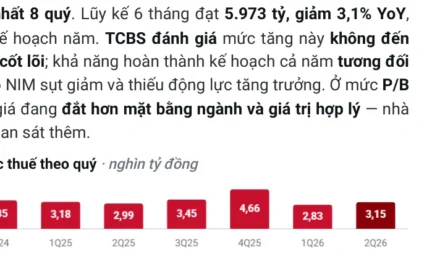



While many private banks are boasting double or triple-digit profit growth in the first half of 2026, Loc Phat Vietnam Commercial Joint Stock Bank (LPBank, HOSE: LPB) has chosen a quieter script: profits remained almost flat compared to the same period last year. But behind that seemingly calm figure is a return on equity (ROE) that ranks among the highest in the banking sector. Could this be part of the reason why billionaire Pham Nhat Vuong quietly poured his personal funds into LPBank in late June?
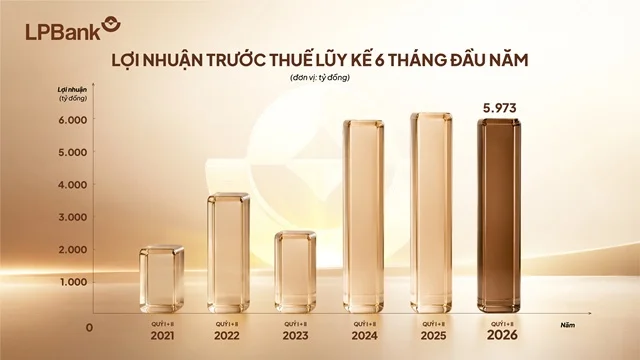
- LPBank’s pre-tax profit reached 5,973 billion VND in H1 2026, completing ~40% of the annual plan; Q2 alone reached 3,147 billion, an 11% increase from Q1.
- ROE reached 21.46%, ROA 1.59% — among the highest in the listed banking system.
- Non-interest income increased by 33% (services +54%, foreign exchange trading +151%), helping reduce dependence on credit.
- Bad debt ratio at 1.85%, CAR at 11.23% — safe, but not among the cleanest in the VN30 group.
- Mr. Pham Nhat Vuong is currently the second-largest shareholder of LPBank with 4.894% of charter capital.
What the profit figures say — and what they don’t?
According to the announcement on July 21, 2026, on Vietstock, LPBank recorded a pre-tax profit of 3,147 billion VND in Q2 2026, up about 11% compared to Q1. Cumulatively for the first 6 months, this figure stood at 5,973 billion VND, completing about 40% of the full-year plan. Looking at the quarter-on-quarter growth, the picture seems positive. However, compared to the same period in 2025, this profit level is almost flat — more of an “stability” than a “boom,” especially when placed alongside other names that announced results this week: Techcombank earned 18,540 billion in the first half (up 22.5%), VPBank reached nearly 18,900 billion (up 68%), or TPBank increased 12.5% to over 4,668 billion, according to a CafeF summary.
In other words, LPBank is not the growth star of this reporting season. But a bank without explosive profit growth isn’t necessarily bad news — the issue lies in where to look to assess a bank’s true “health.” The overall picture of the VN30 banking profit season shows a clear divergence between groups, and LPBank falls into the “stable but not outstanding” category — quite different from the high-growth and declining groups recorded in the H1 2026 VN30 banking business results picture.
ROE of 21.46% is the truly memorable figure
If absolute profit hasn’t impressed yet, LPBank’s return on equity (ROE) is a different story. ROE measures how much profit is generated for every 100 VND of capital shareholders put into the bank — like comparing the efficiency of two coffee shops with the same initial investment; whichever turns over capital faster is more worth investing in terms of capital efficiency. For LPBank, this figure reached 21.46%, while ROA (return on total assets) reached 1.59% — both are in the high range for the listed banking industry.
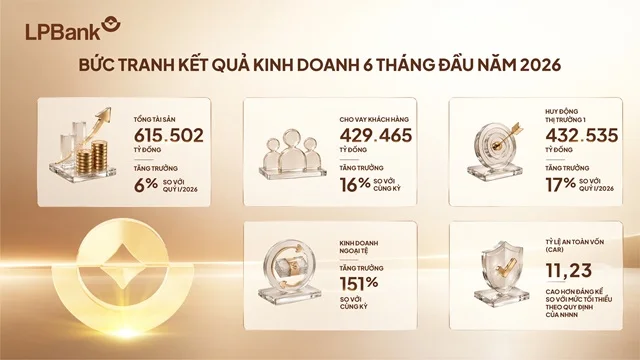
The driving force behind this doesn’t come from credit alone but from diversifying income sources. Non-interest income in the first 6 months reached 3,445 billion VND, up 33% year-on-year, contributing about 31% of total operating income. Notably, revenue from service activities increased by 54%, while the foreign exchange trading segment surged by 151% — a remarkable increase showing the bank is effectively capitalizing on exchange rate fluctuations and the international payment needs of corporate clients.
Of course, there’s no such thing as a free lunch. LPBank’s cost-to-income ratio (CIR) rose to 32.88% as the bank is pouring money into technology and network expansion, with the most visible mark being the launch of the LPBank Plus digital banking app. This is a short-term investment that reduces current profits in exchange for expectations of a more sustainable growth foundation in the future — a familiar trade-off that investors need to consider when comparing ROE among major banks in Vietnam.
Capital adequacy and bad debt: Where does LPBank stand in the VN30?
Regarding asset quality, LPBank’s non-performing loan (NPL) ratio was controlled at 1.85% as of the end of June 2026, while the capital adequacy ratio (CAR) reached 11.23% — significantly higher than the minimum level regulated by the State Bank. The loan-to-deposit ratio (LDR) stood at 76.55%, and the ratio of short-term capital used for medium and long-term loans was 22.25%, both within safe zones.
Compared to other VN30 banks that just announced preliminary results, LPBank falls into the middle group: not as clean as Vietcombank (NPL below 1%), but also far from Sacombank’s situation — the only bank in the group to record a spike in bad debt to 5.6% and a nearly 50% drop in profit, as analyzed in the article on VCB holding firm, STB bad debt at 5.6%. A bank with an NPL below 2% and CAR above 11% is still considered to be in a comfortable zone, with enough room to expand credit in the second half of the year without having to struggle with provisioning.
What is Pham Nhat Vuong seeing in LPBank?
The LPBank story is hard to separate from one name: Mr. Pham Nhat Vuong. According to LPBank’s disclosure, as of June 23, 2026, Mr. Vuong holds 146.2 million LPB shares, corresponding to 4.894% of the charter capital, becoming the bank’s second-largest shareholder — second only to Vietnam Post (VNPost) with 6.537%, according to CafeF. This has been confirmed as a personal investment from idle capital, unrelated to participation in the bank’s management or governance.
Interestingly, this investment appeared exactly during a phase when LPBank was not a profit growth star, but rather a bank with an efficient capital base (high ROE), cautious risk management (NPL and CAR in safe zones), and an ongoing investment in long-term digital infrastructure. Looking through the logic of value investing, this could be a signal that large investors are betting on the quality of the foundation rather than short-term profit growth — something analyzed in more detail in the article on the timing of billionaire Pham Nhat Vuong’s 6,700 billion investment in LPBank.

Investor’s perspective: opportunities and risks
On the opportunity side, LPBank’s scale of operations is expanding steadily: total assets reached 615,502 billion VND, nearly touching the full-year target of 615,600 billion after just half a year; customer loans increased by 16% year-on-year, and capital mobilization increased by 17%. The strong credit growth momentum in Q2 (adding about 26,000 billion) creates room for the bank to accelerate profits in the last two quarters of the year, as new loans begin to generate full interest.
On the risk side, the CIR increasing to nearly 33% means the bank is spending more on operations and technology — if these investments do not translate into corresponding revenue growth, profit margins could continue to be eroded. Additionally, with cumulative profit only completing 40% of the annual plan, there is significant pressure on the second half of the year, requiring the bank to maintain credit growth and control capital costs better than in the first half.
Happite does not provide recommendations to buy or sell any stock. The above figures are merely data for investors to compare against their own risk appetite and investment goals.
Frequently Asked Questions
How much profit did LPBank make in the first 6 months of 2026?
LPBank recorded a pre-tax profit of 5,973 billion VND in the first half of 2026, completing about 40% of the full-year plan.
What is LPBank’s ROE in 2026?
As of mid-2026, LPBank’s ROE reached 21.46%, and ROA reached 1.59% — among the highest in the listed banking industry.
What percentage of LPBank shares does Mr. Pham Nhat Vuong own?
According to the latest announcement, Mr. Pham Nhat Vuong holds 146.2 million LPB shares, equivalent to 4.894% of the charter capital, making him the second-largest shareholder after VNPost.
What is LPBank’s current bad debt level?
LPBank’s non-performing loan (NPL) ratio was controlled at 1.85% as of the end of June 2026, with a capital adequacy ratio (CAR) of 11.23%.
Why is LPBank’s profit growing slower than Techcombank or VPBank?
LPBank’s cumulative profit for the first half of the year was almost flat compared to the same period last year, partly because the bank is increasing investment costs in technology and network expansion (CIR rose to 32.88%), while banks like Techcombank or VPBank recorded double or triple-digit profit growth thanks to stronger credit and non-interest income breakthroughs.
This article is for informational and educational purposes only, not an investment recommendation. You should conduct your own research or consult a licensed expert before making decisions.